





Have you ever wondered why most startups fail to launch, despite having good ideas and strong teams? A product is launched with a lot of enthusiasm, some interest is acquired, but after some time, growth stalls. Users leave, and it’s hard to figure out what went wrong.
In reality, most startups don’t fail due to a lack of funds or skill; they fail because they never find out what people genuinely want. Research indicates that nearly 42 percent of startups fail because their products do not address a real problem.
Marc Andreessen first described this idea and explained product-market fit as being in a good market with a product that can satisfy it. It’s that time when things just start to happen. Customers find value, they stay, and then the business begins to grow..
And it isn’t easy to reach there. Many companies use outdated marketing funnels that serve the same process to everyone. Instead of personalizing the process and messages, all the audiences are guided along the same steps. And the result is unclear signals.
This is where personalization in funnels comes into play. Rather than forcing the journey into one rigid mold, it ends up being shaped by who the visitor is and what matters to them. Personalization reveals patterns: you see which groups respond, which messages land, and where your real fit lies.
And the impact is real. According to McKinsey, companies that lead in personalization generate about 40 percent more revenue than their peers. Personalization accelerates learning, builds better connections, and brings you closer to what the market really wants.
In this blog, we will discuss how personalized funnels work; why traditional funnels most often fall short; and how personalization can help you fast-track your journey to achieving product-market fit.
1. Why One-Size-Fits-All Funnels Fail
After considering how personalization helps discover product-market fit, we now turn to what makes the conventional funnel a limitation.
Most companies still use a basic funnel, forcing everyone through the same steps. This seems logical, but in practice, it treats every visitor alike. Small startups and big enterprises each see the same landing page, are bombarded with the same message, and often follow the same follow-up.
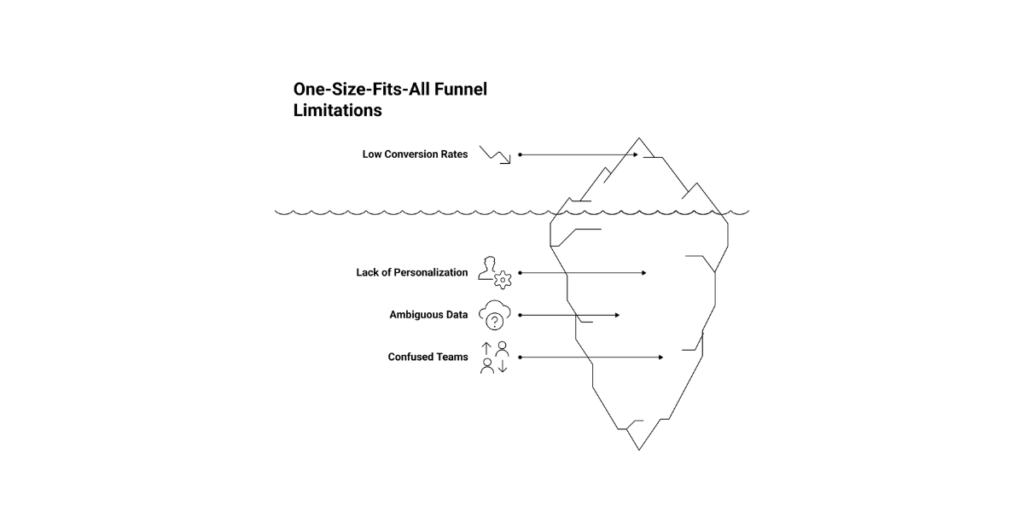
Now comes the disconnect: when a message does not align with someone’s needs, they begin to shut down. According to McKinsey, 71 percent of consumers seek a personalized experience and feel most frustrated when they do not receive one. Your funnel may already be turning people away before they even consider your product.
Thus, the so-called leaky bucket problem is created. Visitors may be brought in, but if the experience is not speaking to them, they will leave. In fact, according to WordStream, the average landing page conversion rate across all industries is just over 2%. This is a lot of missed opportunities right on top of the funnel.
It also affects what you are learning. Without personalization, the data you gather becomes somewhat ambiguous to interpret. Some users sign up, some bounce, but it’s hard to tell why. Are they serious buyers? Was the product message wrong? When everybody sees the same thing, we lose the ability to tell what is genuinely working.
And this confusion spreads. Marketing teams end up reaching broad audiences that may never convert. Product teams are chasing feedback that does not reflect the needs of their top users. Efforts are being put in, but the signals lead nowhere useful.
Take a SaaS company offering a project management tool. Showing the same homepage and demo to both a startup and a large enterprise will leave the former feeling overwhelmed, while the latter will feel underwhelmed. This would result in low conversions and conflicting feedback. With no clear insights, the team is lost on whom to prioritize or how to improve the product.
Read: Future-Proof Ventures: Startup Ideas for the Next Big Tech Wave
2. Use Data to Segment Your Audience Smartly
Now that we have unpacked the traditional funnel’s drawbacks, the question becomes “How can we make it better?” And the answer is DATA.
Personalization sounds like a great idea, but it only works best when you actually understand your audience. If you do not know the one who is walking down the path, you certainly cannot tailor the journey. This is where segmentation comes in-and, of course, good segmentation begins with good data.
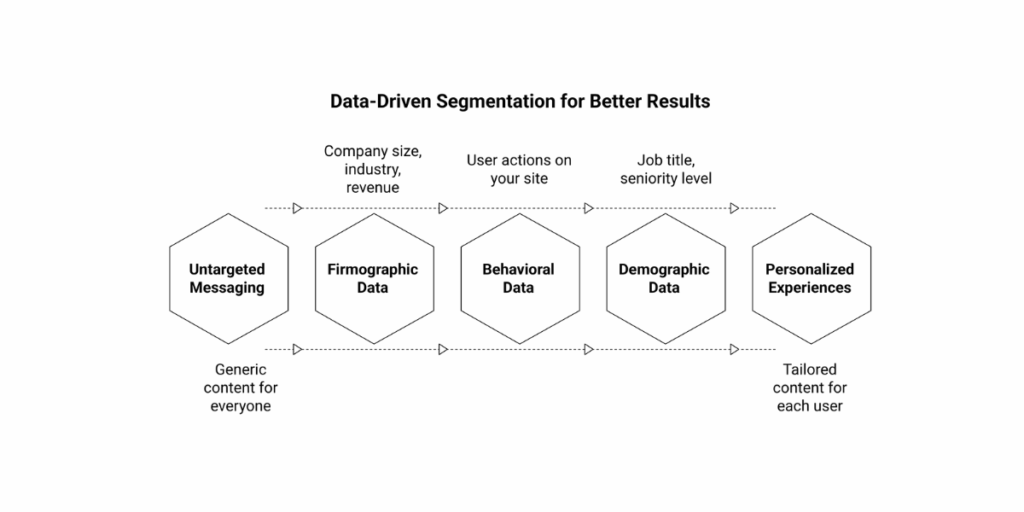
These are the three types to be noted. First is firmographic data. This comprises the size of the company, industry and revenue. It helps you distinguish between a small team and a large organization so you can craft messaging that makes sense to each.
Then there’s behavioral data. This looks at what users do with your site; are they spending time on the pricing page? Did they attend a webinar, or did they test out a feature? Such actions show us their intent and the topics that interest them most.
Eventually, we have demographic data like job title or seniority. A founder will probably be looking for strategy-level value, while a marketing manager will care more about execution. Knowing who is consuming your content helps target them with the right message at the right time.
Once you have this information, you can start making useful segments. Instead of guessing, you use those facts to segment people based on similar behaviors or characteristics. For example, enterprise marketers in fintech or growth-oriented startup founders. These are not just categories; they are gateways to experiences that are much more relevant.
The payoff for doing this right is tremendous. Campaign Monitor states that segmented emails can generate up to 760% higher revenue than non-segmented emails. That is not a little difference. Segmentation is like sharpening a message, and sharper messages drive results.
Around that, Salesforce found something similar: two-thirds of customers are willing to spend more for a superior experience. People want to feel noticed and understood, and segmentation makes that happen on a large scale.
Some firms implement this extremely well; for example, HubSpot asks visitors to identify their roles and company sizes early on in the experience. From that point onward, everything they see in terms of content and tools, and even the CTAs displayed to them, is tailored to that input. A small agency marketer and a sales lead from a large company would have two radically different journeys, even though they began in the same place.
3. Personalize Every Step of the Funnel
Now that we have defined our segments using the right data, the next step is putting that knowledge into action. Personalization takes over the journey from here on, not a mere transformation on the surface but the entire experience reflecting who the audience is and what they care about.
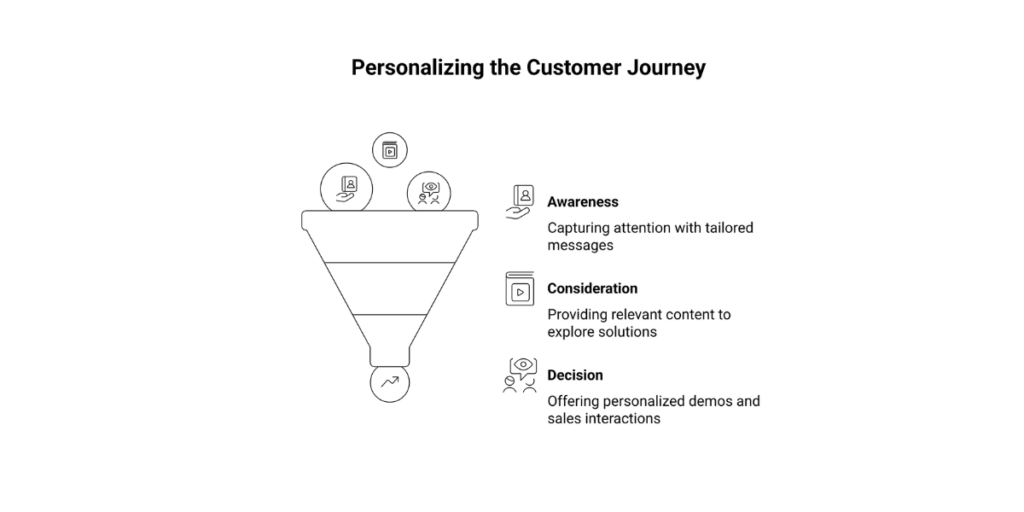
- Top of Funnel (Awareness):
At the top of the funnel, our goal is to catch attention. Instead of giving a uniform message to all, we can address the challenge directly for each segment. A fintech marketer and a SaaS founder both might need the product, but their connection will be through very different words. Once they click through to the landing page, this conversation will continue. Headlines, visuals, and testimonials, all of which can be contextualized to make the experience feel warm and relevant.
- Middle of Funnel (Consideration):
When people enter the consideration stage, our content should help them examine solutions that fit into their world. Examples include powerful case studies, webinars, and guides that feel specific to the industry or job role. Even the emails should mimic their behavior. If someone downloaded a pricing guide or went to the onboarding page, the following correspondence should take that into account. Every single step should feel like a gracious continuation of their interest.
- Bottom of Funnel (Decision):
At the point where someone would decide on something, personalization elicits a higher level of relevance. A product demo that showcases their use case would convince them much faster than a general overview. Suppose our sales team comes in; we may equip them with real context-what the lead read, where they clicked, and which features were explored. Co-created conversations do not just feel generic but feel useful.
Personalization at scale exists beyond SaaS. For example, Netflix does not just recommend new shows; it also changes its artwork based on viewing behavior. An action movie fan sees an image quite different from that of the romantic comedy buff. It’s a small detail, but it increases engagement in a big way.
4. Turn Feedback into Faster Product-Market Fit
Personalizing each stage in the funnel enhances the customer experience and sheds light on what exactly works. That’s where personalization begins to support the path to product-market fit directly.
Another mystery with traditional funnels! People sign up or drop off, but we may never know why. Enter personalized funnels: suddenly those actions start to make sense. We stop asking the bigger questions such as do people want our product, and begin to ask more laser-focused questions. Do fintech marketers find our solution engaging? Are startup founders finding a specific feature of value?
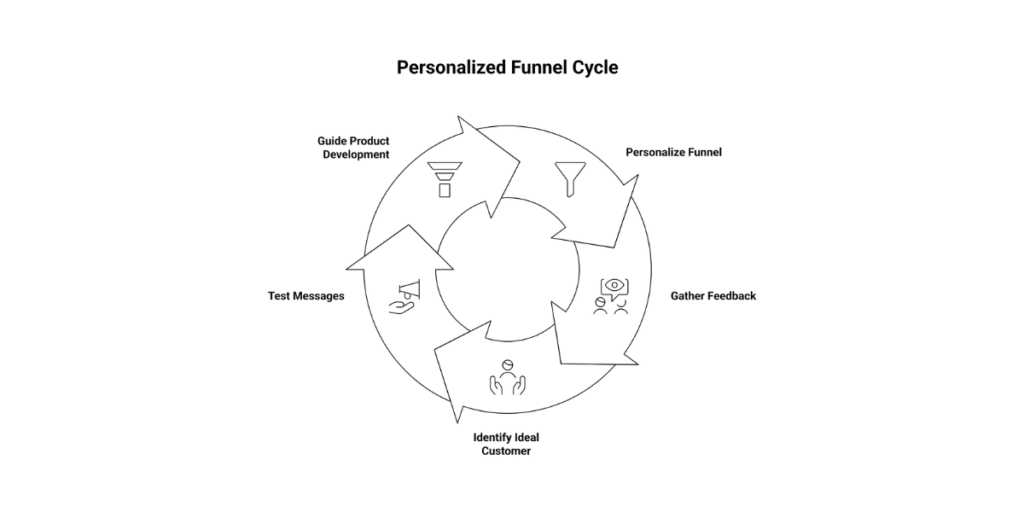
This kind of clarity helps identify the ideal customer profile. When a group converts better, stays longer, and engages deeper, it is a strong indicator that this segment is worth paying attention to again. Instead of spreading our attention too thin, let’s invest where signals are strongest.
Testing which messages resonate with which audiences becomes really easy. It allows us to create different versions of value propositions for our different segments; thus we see the action driving language. This learning helps us be more direct about what each audience cares about, improving marketing and product positioning.
More importantly, this feedback helps guide what we build. Usage patterns and requests from high-performing segments tell us which features matter most. We begin shaping the roadmap around the right people instead of reacting to scattered input.
An excellent approach was one adopted by Superhuman. They asked users how they would feel if they couldn’t use the product anymore. If over 40 percent said they would be very disappointed, it was classified as a sign of product-market fit. Yet the team measured this only within the boundaries of their ideal customer segment. They recognized that not all feedback carried equal weight and thus focused on responses that resonated with their core audience.
The idea of closely listening to the right crowd has backing by more extensive research. The McKinsey report says that companies that lean into customer analytics are much more likely to outperform competitors in acquiring new customers, building loyalty, and achieving profitability.
Conclusion
By turning vague customer signals into actionable insights, personalized funnels take a faster, clearer route toward product–market fit. Unlike old-school funnels, these newer avenues help companies pinpoint the right audience, fine-tune messaging, and allocate resources to what matters most.
A good point to start for the teams will be not to throw everything away from the beginning. They can select a promising segment, develop a custom journey, measure what works, and iterate. This simple, focused step is often the fastest route to true market fit.
Author’s Bio:
Vidhatanand is the Founder and CEO of Fragmatic, a web personalization platform for B2B businesses. He specializes in advancing AI-driven personalization and is passionate about creating technologies that help businesses deliver meaningful digital experiences.